
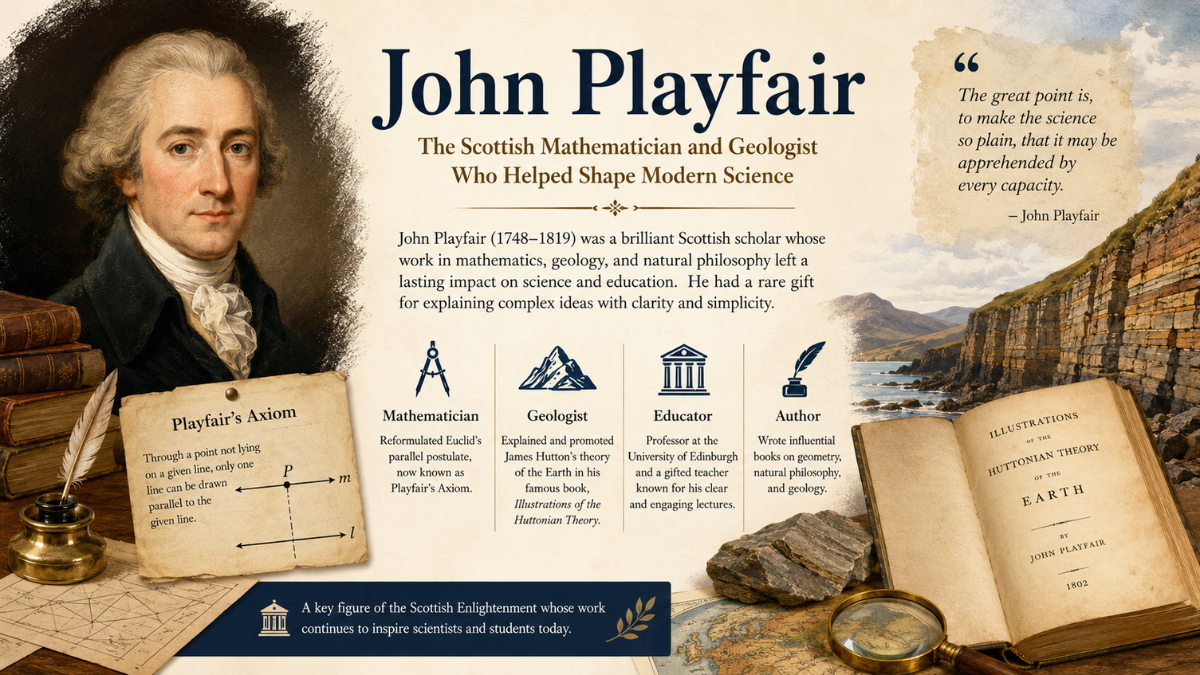
John Playfair is remembered as one of Scotland’s most influential scientists and intellectuals. Although many people recognize his name because of Playfair’s Axiom in geometry, his contributions reached far beyond mathematics. He was a respected geologist, physicist, professor, and author whose work helped popularize important scientific theories during the late eighteenth and early nineteenth centuries.
Born during the Scottish Enlightenment, Playfair lived in a period when science and philosophy were rapidly evolving. He became a central figure among scholars who sought to understand the natural world through observation and logical reasoning. His ability to explain complex ideas in simple terms earned him admiration from fellow scientists and students alike.
Today, historians regard John Playfair as one of the key figures who helped spread the groundbreaking geological theories of James Hutton and strengthened the foundations of mathematics education. His influence continues to be felt in classrooms and scientific discussions around the world.
Early Life and Education
John Playfair was born on March 10, 1748, in Benvie, near Dundee, Scotland. He was the eldest son of Reverend James Playfair, who served as a minister in the Church of Scotland. Growing up in an intellectually stimulating environment, young John displayed exceptional talent and curiosity from an early age.
After receiving his early education at home and local schools, he entered the University of St Andrews at the age of fourteen. His remarkable mathematical abilities quickly became evident. Professors recognized his talent, and he excelled in subjects ranging from mathematics and philosophy to theology.
Following the death of his father, Playfair assumed additional family responsibilities. Despite these challenges, he continued pursuing academic excellence. His determination and dedication allowed him to establish himself among Scotland’s leading scholars before reaching middle age.
Academic Career and Teaching Achievements
John Playfair began his professional journey as a minister, but his passion for mathematics and science eventually guided him toward academia. In 1785, he became Professor of Mathematics at the University of Edinburgh, one of Europe’s most prestigious institutions.
As a teacher, Playfair possessed a rare gift for making difficult concepts understandable. His lectures attracted students from various backgrounds, and his reputation for clarity and precision made him one of the most respected educators of his era. He emphasized logical reasoning and encouraged students to think critically rather than simply memorize formulas.
Later, in 1805, Playfair was appointed Professor of Natural Philosophy at the University of Edinburgh. In this role, he taught subjects closely related to modern physics. His influence extended beyond the classroom, helping shape the scientific culture of Scotland during a period often referred to as the Scottish Enlightenment.
Contributions to Mathematics
John Playfair made significant contributions to mathematics, particularly through his work on Euclidean geometry. His most famous legacy is known today as Playfair’s Axiom, an alternative statement of Euclid’s parallel postulate.
John Playfair, The principle states that through a point not lying on a given line, only one line can be drawn parallel to the original line. Although this idea originated from Euclid’s work, Playfair presented it in a simpler and more elegant form. His formulation became widely accepted and remains a standard part of geometry education.
In addition to his work on geometry, Playfair published important mathematical texts that improved teaching methods and increased accessibility for students. His writings demonstrated his belief that mathematics should be taught clearly and systematically, making the subject less intimidating for learners.
John Playfair and the Development of Geology
While mathematics brought him recognition, geology became another area in which Playfair made an extraordinary impact. He was a close friend and supporter of James Hutton, the scientist now considered the father of modern geology.
Hutton proposed revolutionary ideas regarding the Earth’s formation and the immense timescales involved in geological processes. However, many readers found Hutton’s original writings difficult to understand. Playfair recognized the importance of these theories and decided to explain them more effectively.
In 1802, he published Illustrations of the Huttonian Theory of the Earth, a work that presented Hutton’s concepts in a clear and accessible manner. This book played a vital role in spreading the theory of uniformitarianism, which suggests that the same natural processes observed today have operated throughout Earth’s history.
Thanks largely to Playfair’s efforts, Hutton’s ideas gained broader acceptance and laid the foundation for modern geology. Many historians believe that without Playfair’s explanations, Hutton’s theories might not have achieved the same influence.
Involvement in the Scottish Enlightenment
John Playfair lived during one of the most intellectually vibrant periods in European history. The Scottish Enlightenment brought together philosophers, economists, scientists, and writers who transformed numerous fields of study.
Playfair maintained friendships with several prominent thinkers, including Adam Smith, Joseph Black, and James Hutton. These relationships fostered an environment of collaboration and innovation. Intellectual discussions among these scholars encouraged groundbreaking discoveries and new approaches to scientific inquiry.
As a member of the Royal Society of Edinburgh, Playfair contributed actively to scientific advancement. His publications and lectures reflected the Enlightenment ideals of reason, observation, and evidence-based thinking. Through his work, he helped establish Scotland as an international center for learning and scholarship.
Publications and Literary Style
One of John Playfair’s greatest strengths was his ability to communicate scientific ideas with elegance and clarity. Unlike many scholars of his time, he avoided unnecessarily complicated language. His writing style combined precision with accessibility, making advanced subjects easier to understand.
Among his most important works were:
- Elements of Geometry
- Illustrations of the Huttonian Theory of the Earth
- Outlines of Natural Philosophy
- Various essays and biographies of notable scientists
His publications earned praise not only for their scientific accuracy but also for their literary quality. Readers appreciated his logical explanations and thoughtful presentation of complex concepts.
Playfair believed that scientific knowledge should be shared widely rather than restricted to specialists. This philosophy contributed significantly to the popularity and influence of his writings.
Personal Character and Reputation
Contemporaries described John Playfair as kind, modest, and intellectually curious. Despite his achievements, he maintained a humble personality and treated colleagues and students with respect. His approachable nature made him popular within academic circles.
Friends admired his conversational abilities and his willingness to engage in thoughtful debates. He possessed a calm demeanor and preferred reasoned discussion over confrontation. These qualities strengthened his reputation as both a scholar and a gentleman.
His commitment to truth and education reflected the values of the Enlightenment. Those who knew him personally often emphasized not only his intelligence but also his integrity and generosity.
Death and Lasting Legacy
John Playfair passed away on July 20, 1819, in Edinburgh, Scotland. His death marked the end of an extraordinary career that had influenced mathematics, geology, and scientific education.
Today, his name continues to appear in textbooks through Playfair’s Axiom. Geologists also recognize his essential role in promoting James Hutton’s revolutionary ideas. Numerous historians consider him one of the most important scientific communicators of his generation.
Monuments and memorials in Scotland honor his achievements, while his writings remain valuable resources for understanding the history of science. His ability to bridge different disciplines demonstrates the remarkable breadth of his intellectual talents.
More than two centuries after his death, John Playfair remains a symbol of curiosity, scholarship, and the pursuit of knowledge. His work reminds us that scientific progress depends not only on discovering new ideas but also on explaining them in ways that others can understand and appreciate.
Conclusion
John Playfair occupies a unique place in the history of science. As a mathematician, educator, geologist, and writer, he contributed significantly to the advancement of knowledge during the Scottish Enlightenment. His clear explanations transformed complex theories into accessible ideas and helped shape the development of modern mathematics and geology.
Although he may not be as widely known as some of his contemporaries, his influence remains profound. Through his teachings, publications, and support of revolutionary scientific theories, John Playfair left a legacy that continues to inspire scholars and students alike.
His life serves as a reminder that great achievements are often built not only through discovery but also through the ability to communicate knowledge effectively and encourage others to explore the wonders of science.